Here are a few recordings of interviews that were held to get some qualitative feedback on our Poster and Magazine Review Page. As with one of the Short Film feedback sessions, we interviewed media students and a media teacher, so that we would get a more detailed analysis of our work.
Tom has only been able to upload three of the six recordings due to technical error.
Unlike our Short Film, which wasn't received brilliantly, both of our ancillary products were very well received. In summary, people thought highly of the verisimilitude of the review and the authenticity of the poster, and agreed that both would fulfill their purposes well.
An in-depth explanation of what we learned from all of our feedback can be found here in my Evaluation Prezi.
Showing posts with label Audience. Show all posts
Showing posts with label Audience. Show all posts
Thursday, 24 March 2011

Audience Feedback on Main Task: Session 1
Here is a video recording of the first of two planned qualitative feedback sessions for our short film. The audience was comrpised of media students and a media teacher, so Tom and I tried to ask questions that would take advantage of their heightened ability to pull texts apart and analyse them in-depth.
The audience response wasn't, perhaps, as positive as we would have liked, but it still brought up some significant points. In summary, although the film is visually accomplished, and the sound is well edited, some of the audience found the surreal narrative too confusing, and this detracted from their enjoyment of the film.
An in-depth explanation of what we learned from all of our feedback can be found here in my Evaluation Prezi.
Tuesday, 1 February 2011
Quantitative Audience Research: Analysis
Although the questionnaire has only been live for 4 days, the results are already revealing enough for me to begin considering them and applying them to our products.
Poster
In order to know what size and shape of poster we should create, we first need to know where the poster will be displayed, so we asked people where they thought film posters were most effective. As the graph below shows, there were three options that stood out:

This indicates that, if Tom and I want to advertise our film in what is deemed to be the most effective area, we should produce a poster for display in and around cinemas and multiplexes. What the reasonable spread of data across all choices suggests, though, is that film posters are always somewhat effective, no matter where they are displayed. It may well be worth producing three different versions of the same poster for the three most-selected options.

The next question was concerning the features of a film poster. The summary graph shows that there were two main features people wanted to see: an eye-catching image, and images of the characters or actors. Although our current plan for the poster is certainly 'eye-catching', with lots of faces staring out at viewers, the entire point of it is that the protagonist is not seen, so that a sense of mystery is created. According to the results, however, a sense of mystery is not so important. Tom and I will certainly have to consider either changing our poster design, or producing a number of posters which will appeal to different tastes.
Review
The first question of this section asked people what they look for in a good film review, and the answers were pretty much as expected, with images from the actual film, the film release date and a clearly defined rating of the film all ranking in the top answers. Interestingly, two other popular selections were comparisons to other films and an unbiased perspective. The former three factors I mentioned were already going to be included in our review, but the latter two are both aspects we will have to consider including. The unbiased perspective will be the most challenging, because it necessitates an impartial writing style, which may be difficult to acheive considering we are the ones making the film.

The other two questions in this section were asked so that we could determine the placement of our review page; in what magazine, and in what section. The pie-charts below are very useful in summarising the results.

What they tell us is that large, in-depth reviews are favoured slightly over small, concise reviews, and that, overall, people would like to see short-film reviews as a new feature in an existing magazine such as Empire or Total Film. We are currently aiming to have two reviews of short films on our review page, with one being a review for our own film, and i think our plans will stay this way. There is not enough of a difference in the first pie-chart to push us into writing one large review of our own film, because this would not be read by those looking for shorter reviews. At the same time, however, a review filling half a magazine page is not as short as reviews go, so we are striking a compromise to try and satisfy both types of reader. Moreover, these reviews are going to have to look as if they belong in a real, new section in an existing film magazine, and, realistically, such magazines would only be likely to dedicate half a page at most to the review of a short film.
General
The general questions we asked relating to film were included simply so that Tom and I could confirm we were on the right tracks.

Out of thriller, mystery and drama - the three genres that our Short Film aims to combine - thriller is clearly the most popular; perhaps more popular than mystery and drama than we expected. Although we're not going to turn around and re-write our film to cater more for thriller-lovers, we can alter our poster (or one of our posters, if we produce more than one) to make the film appeal to these people on first impressions.

The question about how people discuss film was included solely to confirm the legitimacy of the two-step flow audience model, and this is exactly what it has done. What it also shows, quite interestingly, is that, despite the popularity of social networking, people are still more likely to talk to one-another about film in face-to-face conversation rather than via the internet. All the more reason, then, for Tom and I to produce a poster and review that are interesting and engaging enough to provoke discussion.
Poster
In order to know what size and shape of poster we should create, we first need to know where the poster will be displayed, so we asked people where they thought film posters were most effective. As the graph below shows, there were three options that stood out:
- Outside/within a cineama.
- In a magazine.
- On the internet.

This indicates that, if Tom and I want to advertise our film in what is deemed to be the most effective area, we should produce a poster for display in and around cinemas and multiplexes. What the reasonable spread of data across all choices suggests, though, is that film posters are always somewhat effective, no matter where they are displayed. It may well be worth producing three different versions of the same poster for the three most-selected options.

The next question was concerning the features of a film poster. The summary graph shows that there were two main features people wanted to see: an eye-catching image, and images of the characters or actors. Although our current plan for the poster is certainly 'eye-catching', with lots of faces staring out at viewers, the entire point of it is that the protagonist is not seen, so that a sense of mystery is created. According to the results, however, a sense of mystery is not so important. Tom and I will certainly have to consider either changing our poster design, or producing a number of posters which will appeal to different tastes.
Review
The first question of this section asked people what they look for in a good film review, and the answers were pretty much as expected, with images from the actual film, the film release date and a clearly defined rating of the film all ranking in the top answers. Interestingly, two other popular selections were comparisons to other films and an unbiased perspective. The former three factors I mentioned were already going to be included in our review, but the latter two are both aspects we will have to consider including. The unbiased perspective will be the most challenging, because it necessitates an impartial writing style, which may be difficult to acheive considering we are the ones making the film.

The other two questions in this section were asked so that we could determine the placement of our review page; in what magazine, and in what section. The pie-charts below are very useful in summarising the results.

What they tell us is that large, in-depth reviews are favoured slightly over small, concise reviews, and that, overall, people would like to see short-film reviews as a new feature in an existing magazine such as Empire or Total Film. We are currently aiming to have two reviews of short films on our review page, with one being a review for our own film, and i think our plans will stay this way. There is not enough of a difference in the first pie-chart to push us into writing one large review of our own film, because this would not be read by those looking for shorter reviews. At the same time, however, a review filling half a magazine page is not as short as reviews go, so we are striking a compromise to try and satisfy both types of reader. Moreover, these reviews are going to have to look as if they belong in a real, new section in an existing film magazine, and, realistically, such magazines would only be likely to dedicate half a page at most to the review of a short film.
General
The general questions we asked relating to film were included simply so that Tom and I could confirm we were on the right tracks.

Out of thriller, mystery and drama - the three genres that our Short Film aims to combine - thriller is clearly the most popular; perhaps more popular than mystery and drama than we expected. Although we're not going to turn around and re-write our film to cater more for thriller-lovers, we can alter our poster (or one of our posters, if we produce more than one) to make the film appeal to these people on first impressions.

The question about how people discuss film was included solely to confirm the legitimacy of the two-step flow audience model, and this is exactly what it has done. What it also shows, quite interestingly, is that, despite the popularity of social networking, people are still more likely to talk to one-another about film in face-to-face conversation rather than via the internet. All the more reason, then, for Tom and I to produce a poster and review that are interesting and engaging enough to provoke discussion.
Thursday, 27 January 2011
Quantitative Audience Research
In an earlier post, I mentioned that Tom and I would be creating and sending an online questionnaire for quantitative audience research. Now, that questionnaire has been constructed, and it contains all the questions we thought would provide us with answers and statistics which will prove useful in the final stages of production of our media texts.

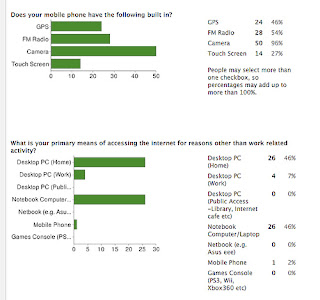
To create the questionnaire, Tom and I used Google Forms, which was recommended by a friend. Google Docs is a free application that allows users to create, organise and store office documents online. The 'form' is just one type of document that Google Docs allows users to create and publish. For a free-to-use application, Google Forms looks extremely professional and is very easy to use. What's more, it automatically collects responses in a spreadsheet, and also organises them into individual graphs and charts for quick and easy interpretation, as shown in the example below.
The quantitative results won't change our texts enormously, because they are our creative ideas, and, naturally, we wish to see them through. What the results will do, however, is allow us to gear our texts towards the most receptive groups of people, ensuring that they reach as larger audience as possible.

Above is a screenshot of the post I added to the A2 Media Studies group on Facebook, asking people politely to take some time to fill out the questionnaire, and below is a screenshot showing the look and format of the questionnaire.

Click here to go to the questionnaire.
When Tom and I think we have enough results, I will close the questionnaire to responses and analyse the results.

To create the questionnaire, Tom and I used Google Forms, which was recommended by a friend. Google Docs is a free application that allows users to create, organise and store office documents online. The 'form' is just one type of document that Google Docs allows users to create and publish. For a free-to-use application, Google Forms looks extremely professional and is very easy to use. What's more, it automatically collects responses in a spreadsheet, and also organises them into individual graphs and charts for quick and easy interpretation, as shown in the example below.

The quantitative results won't change our texts enormously, because they are our creative ideas, and, naturally, we wish to see them through. What the results will do, however, is allow us to gear our texts towards the most receptive groups of people, ensuring that they reach as larger audience as possible.
Above is a screenshot of the post I added to the A2 Media Studies group on Facebook, asking people politely to take some time to fill out the questionnaire, and below is a screenshot showing the look and format of the questionnaire.

Click here to go to the questionnaire.
When Tom and I think we have enough results, I will close the questionnaire to responses and analyse the results.
Saturday, 11 December 2010
Potential Target Audience
Since deciding upon our brief, Tom and I have always had target audience at the back of our minds; influencing all of our research and planning so far.
Follow this link to the research I carried out during last year's AS project, which still applies to the current project.
Although we have a vague idea of our potential target audience: active viewers between the ages of 14 and 50, who enjoy a mystery and like to discuss film with others (as in the two-step flow audience model), we will need to carry out our own research to accurately determine our actual target audience, and to clarify what we can do to make our products appeal to them.
Seeing as Tom studies Business, he will be leading the research on our Target Audience.
Follow this link to Tom's post on 'Analysing and Choosing a Target Audience.'
Follow this link to Tom's in-depth post on Target Audience specifically for our Poster.
When we get to the stage of actually carrying out the research, both myself and Tom will be involved in the qualitative side (showing people test footage and asking questions about it) as well as the quantitative side (constructing and sending a questionnaire). However, once we have collected the results and the feedback, I will be analysing the quantitative statistics, and Tom will be interpretting the qualitative comments.
Subscribe to:
Posts (Atom)